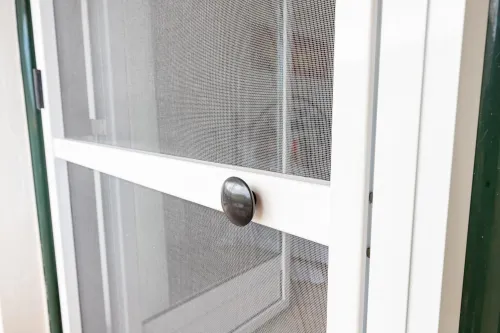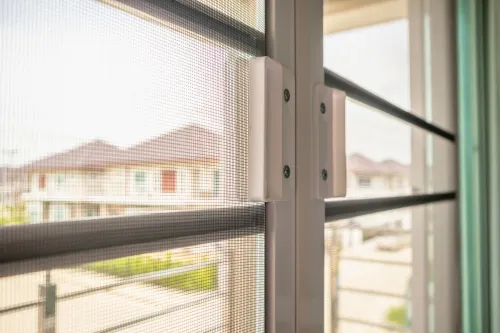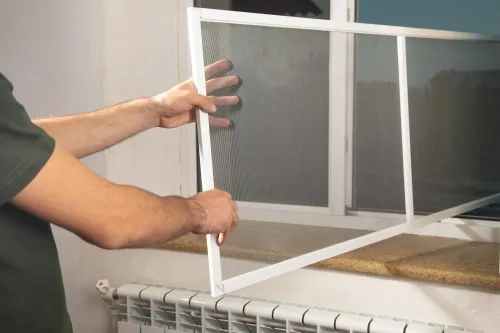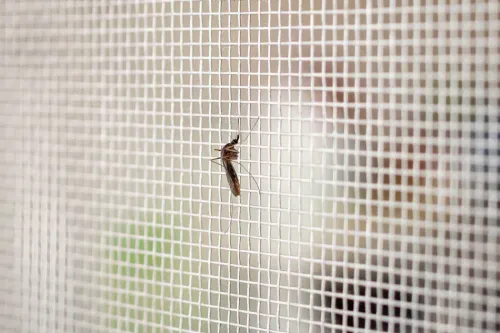

An insect screen lets wind and daylight pass through while creating a physical barrier at the opening, but it does not cool a room, filter pollution, or remove mosquitoes already indoors. By the end, you will know how to operate, measure, inspect, compare, and specify a screen so it supports fresh-air ventilation without creating hidden entry gaps.
Key takeaways
- Mesh blocks insects but does not cool rooms or remove pollutants.
- Clean tears, loose edges, and blocked mesh before they become entry points.
- Measure the full opening, including frame depth and clearance for moving parts.
- Match fixed, Velcro, pleated, roll-down, or barrier-free systems to daily use.
How mesh allows airflow without filtering the air
Open mesh preserves ventilation by leaving thousands of passages for wind and pressure-driven air movement while its openings block insects larger than those passages. It does not cool a room, remove pollutants, or create airflow; ventilation through mosquito mesh still depends on wind, temperature differences, or a fan.
A specification tells you more than the label, but less than many buyers assume:
- Mesh opening size indicates the maximum clear gap available to an insect. Smaller openings improve exclusion but add resistance to airflow.
- Mesh count states how many wires run across a measured length in each direction. It does not state the gap size by itself.
- Wire material, coating, and colour affect durability, visibility, glare, and cleaning, not just appearance.
For example, 18×16 mesh made with 0.011-inch wire has clear openings of roughly 1.13 by 1.31 millimetres and a theoretical open area near 65 percent. Change the wire diameter and both the opening size and airflow change, even though the 18×16 label stays the same.
Ask for the pressure difference and test method behind any airflow claim. A “no-see-um” mesh with finer openings can noticeably restrict passive ventilation where wind is weak, while standard screening can let tiny biting midges or sand flies through.
Dust, pollen, grease, and insect remains also close the effective open area, so cleanable mesh is part of ventilation performance.
How daily use keeps the barrier effective
Close a mosquito net before dusk, when many mosquito species begin seeking entry, and keep it closed while the window or door remains open. During daylight, use intact screened openings for cross-ventilation, but shut unscreened openings and avoid treating the mesh as protection from smoke, fine particles, or polluted outdoor air.
Use this daily check:
- Inspect screen gaps around the frame, corners, fasteners, and door threshold. Reseat removable panels and confirm that the door self-closes.
- Look for tears, loose spline, lifted edges, and damaged seals. Repair holes promptly; a small opening can defeat a large screen.
- Keep doors and windows closed while people pass through, rather than propping them open. Check unscreened weep holes and vents for entry routes.
- Do screen cleaning with a soft brush or vacuum on low power, then wipe with mild soapy water if the material allows it. Remove dust, pollen, grease, and insect remains before they reduce airflow.
A screen provides insect exclusion, not mosquito control. It blocks new arrivals but does not remove mosquitoes already indoors or stop breeding in standing water, so empty outdoor containers and repair leaks separately.
If airflow drops after cleaning, inspect for a blocked mesh, an overly fine replacement, or a closed opening elsewhere; finer mesh trades stronger exclusion for greater resistance.
How to measure the opening and find fitting failures
A screen fits only when its frame matches the opening at every point, not just at the centre. To learn how to measure a window screen, record width and height at the top, middle, and bottom, then use the smallest readings.
Measure door and window frame depth too; a shallow channel can leave the panel proud, loose, or unable to latch.
| Location | Measure | Failure revealed |
|---|---|---|
| Window opening | Width and height at three points | An out-of-square opening that pinches the screen or leaves a corner gap |
| Frame channel | Door and window frame depth | Insufficient seating or a panel that projects into the opening |
| Door threshold | Bottom clearance and contact | A gap beneath the screen where insects can enter |
Inspect the installed edge before ordering or reusing a panel:
- Look for screen wrinkles; they indicate incorrect tension, a distorted frame, or mesh too large for its channel.
- Press along Velcro and replace loose Velcro where the seal lifts under light pressure.
- Check for damaged spline, pulled corners, torn mesh, and bent retaining clips.
- Trace all four edges for perimeter gaps, including the latch side, roller housing, corner joints, and the sill.
- Confirm that weep holes, vents, and the door threshold are screened or sealed without blocking drainage.
Close the door or window and view the frame from inside and outside. Daylight showing through a joint identifies a bypass route; a tight-looking mesh does not correct it.
How to choose between fixed, Velcro, pleated, roll-down, and barrier-free systems
Choose the format by how often you cross the opening, how much frame space you have, and whether anyone must escape through it. A bedroom window used for emergency egress needs a release or removal method that occupants can operate without tools; a fixed panel that cannot be removed is a poor choice there.
| Option | Best fit | Check before choosing |
|---|---|---|
| Fixed screen | Openings that stay screened and need no daily access | Confirm egress compliance, removable retention, and enough frame depth for a secure seal |
| Velcro mosquito screen | Temporary or low-cost fitting where you remove the mesh occasionally | Leave a clean, flat bonding surface and expect adhesive or fabric wear from repeated removal |
| Pleated screen | Frequently used doors needing compact side storage | In a pleated screen comparison, check track clearance, folding resistance, and the threshold height |
| Roll-down screen | Windows or doors opened periodically with vertical storage available | Measure headroom for the roll-down screen cassette and provide space for the mesh to descend straight |
| Barrier-free screen | Doorways where a low threshold matters for wheels, children, or frequent passage | Confirm the system does not leave a perimeter gap when closed and has adequate side or overhead clearance |
Fixed and barrier-free screens solve different problems: one prioritises permanence, while the other prioritises movement. Do not treat any insect screen as fall protection, security glazing, or bird-containment mesh; specify a separate structural system for those risks. Delmen Nets 9650012393 can help compare door and window formats against the opening’s clearance and use pattern.
Related products
 | Insects Screens System Manufacturer and Supplier in Gurgaon We are leading manufacturer of Insect Screen Systems from Gurgaon. View product → |
 | Velcro Mesh Systems Manufacturer and Supplier in Gurgaon Manufacturer of Velcro Mesh Systems - Velcro Net offered by Delmen Nets are of high quality, It protect from the... View product → |
What to confirm before ordering and installing the screen
Before you order, confirm the installed screen will provide enough airflow, exclude the insects you face, and remain safe at the opening. Ask for a stated maximum clear-opening dimension, not only a mesh-count label; smaller biting midges require finer openings, which also increase airflow resistance.
A laboratory permeability figure is not a ventilation rate for a frame with seals, channels, overlaps, or a roller housing.
| Mesh choice | Ventilation and exclusion | Detail to confirm |
|---|---|---|
| Standard insect mesh | Better airflow; blocks ordinary mosquitoes | Check whether smaller local pests can pass |
| Fine no-see-um mesh | Greater exclusion; higher pressure drop | Confirm the reduced airflow suits the room |
| Dark, fine mesh | Usually clearer outward visibility than bright mesh | Compare screen colour and visibility from both sides |
- Confirm the insect-screen coating and thread material, including resistance to sunlight, moisture, cleaning, and repeated flexing.
- Test emergency window egress before installation. A bedroom escape screen must release or remove without tools and comply with your local opening requirements.
- Do not treat light insect mesh as fall protection, security glazing, or bird-containment mesh; each function needs a separately rated system.
- Ask how to remove, wash, dry, and refit the screen. Inspect the mesh, spline, corners, brush seals, and frame channels for tears, gaps, looseness, and clogging, because dirt reduces airflow and a small bypass defeats exclusion.
Frequently asked questions
Does mosquito mesh filter air or cool a room?
No. Mesh leaves passages for wind and pressure-driven airflow, but it does not remove pollutants or create cooling. Ventilation still depends on wind, temperature differences, or a fan.
How do you keep a mosquito screen effective during daily use?
Keep the mesh clean, repair tears, check edge seals, and close the screen fully after passing through it. Inspect corners, fasteners, tracks, and overlaps for gaps.
What should you measure before ordering a mosquito screen?
Measure the opening width and height at multiple points, then record frame depth, sill condition, handle clearance, and the direction of door or window movement.
Which mosquito screen type suits a frequently used opening?
Choose fixed screens for openings that rarely need access, Velcro systems for removable seasonal use, pleated screens for wide openings, roll-down screens for vertical access, and barrier-free systems for frequent passage.
Related products
 | Pleated Mesh Systems Manufacturer and Supplier in Gurgaon Delmen Nets is the manufacturers and the suppliers of an excellent and superior quality of Pleated Mesh Systems... View product → |
 | Mosquito Nets For uPVC Doors Manufacturer and Supplier in Gurgaon Top Grade Mosquito Nets For uPVC doors manufacturers in Gurgaon, Haryana. View product → |
 | Roll Down Mesh Systems Manufacturer and Supplier in Gurgaon Delmen Nets are involved in the manufacturing and supplying of Roll Down Mesh Systems (Roller Mesh or Pull Down... View product → |
 | Barrier free Mesh Systems Manufacturer and Supplier in Gurgaon Delmen Nets are Manufacturer & Supplier of excellent quality Barrier Free Doors Mesh Systems to our valuable... View product → |