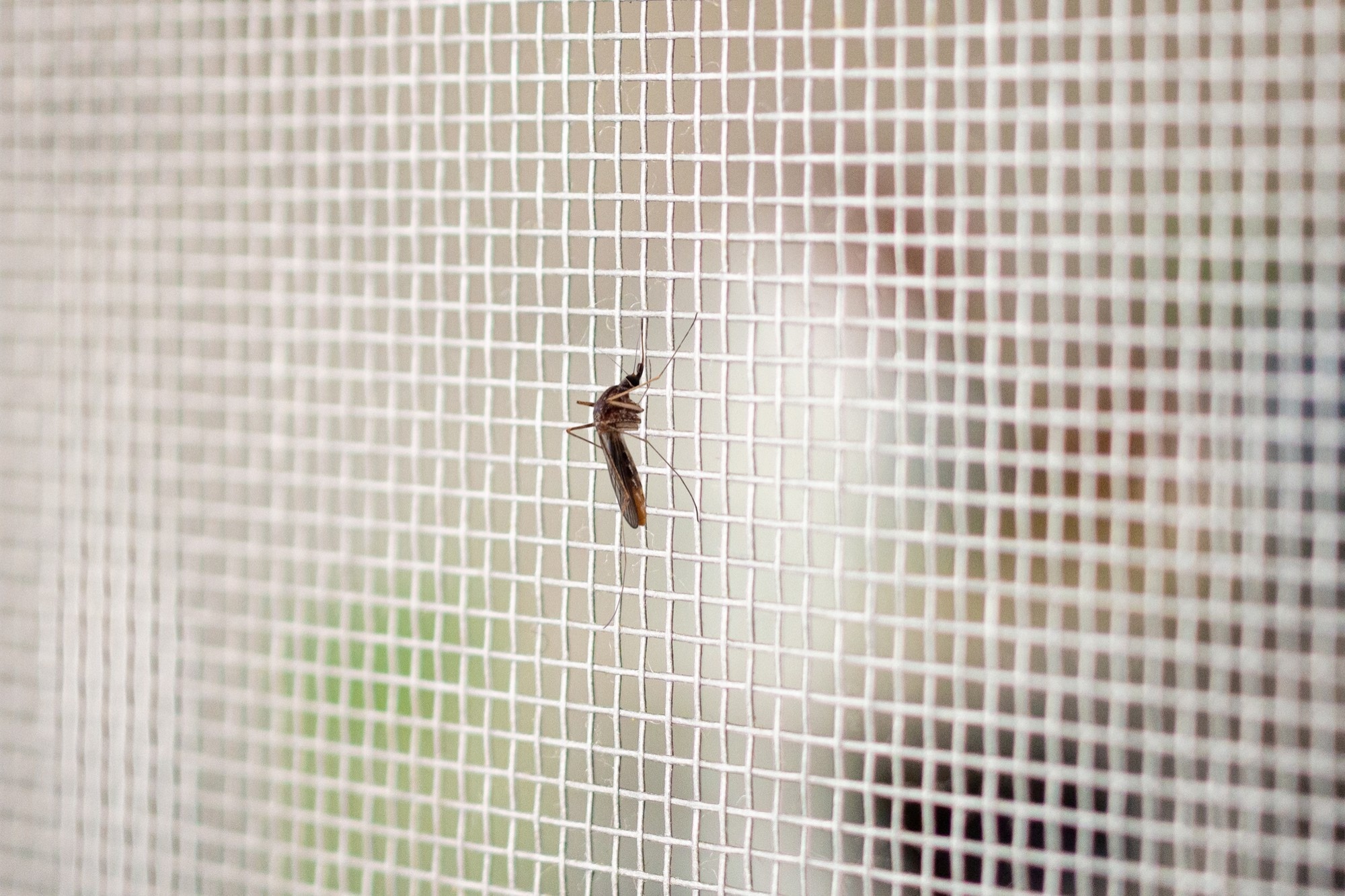
A mosquito net succeeds or fails as an installed system, not as a fabric sample or a low quotation. By checking the opening, mesh specification, seals, hardware, workmanship, documentation and after-sales support, you can compare suppliers on performance rather than promises.
Key takeaways
- Match the screen to opening geometry and how frequently people use it.
- Ask for mesh material, aperture size, and visible proof of performance.
- Inspect frame alignment, brush seals, magnets, rollers, and installation clearances.
- Compare itemised quotations and test every moving panel after installation.
Match the screen system to your opening and daily traffic
A narrow window with little clear space suits a roll-down screen, while a frequently used balcony or patio door needs a sliding mosquito door or pleated mosquito screen built for repeated movement. Choose by opening geometry first, then by traffic.
| Option | Opening and clearance | Daily use |
|---|---|---|
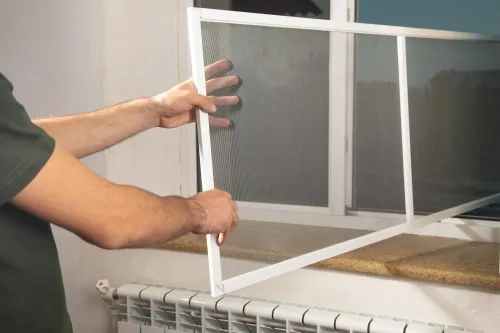
| Velcro mosquito net | Windows or doors with a flat fixing surface and almost no frame clearance; keep the opening clear for removal | Low traffic, seasonal use, or rented homes |
| Roll-down screen | Windows and doors with room above or beside the opening for a cassette and guide channels | Low to moderate traffic |
| Pleated mosquito screen | Wide doors needing a compact, low-profile stack; check side clearance and sill level | Moderate to high traffic |
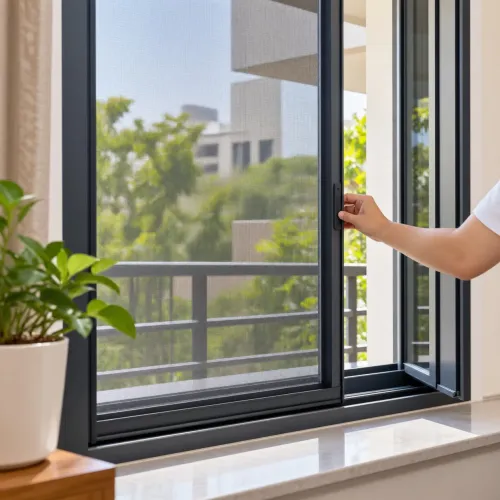
| Sliding mosquito door | Openings with a firm sill and space for tracks and panel overlap | High traffic and frequent passage |
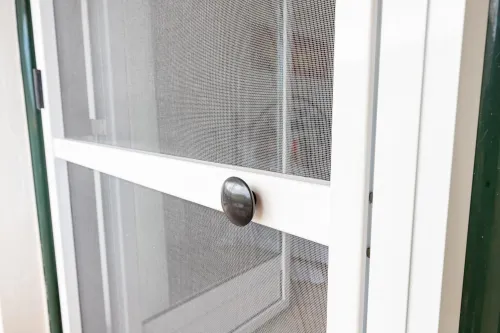
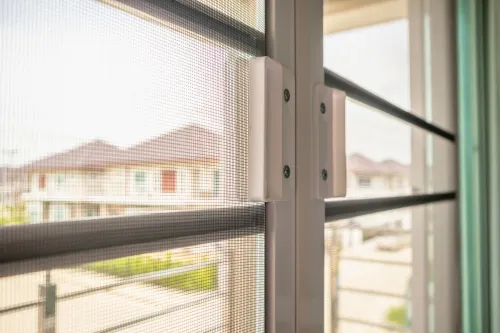
Ask the supplier to show the cassette, guide rails, pull bar, brush seals, bottom track, meeting stile and replacement-part plan. A retractable screen that bows, twists or leaves a gap after ten openings is a poor choice, regardless of its mesh sample.
Test the installed system before acceptance:
- Open and close it repeatedly, then check latch alignment and continuous perimeter sealing.
- Inspect mitred corners, spline retention, sliding-panel overlap and the frame-to-wall interface for gaps.
- Check drainage, cleaning access and removal without damaging the reveal.
- Confirm the bottom seal still touches an uneven sill or threshold.
Do not substitute bird-safety netting for insect screening: its openings can let mosquitoes through, while insect mesh is not a fall-protection barrier.
Demand a measurable mesh specification, not just “mosquito-proof”
Ask for a stated mesh aperture and construction, not the label “mosquito-proof.” An 18×16 mesh is common insect screening, while 20×20 mesh or finer is intended for smaller pests such as no-see-ums and biting midges. The finer option also reduces airflow and daylight, so do not accept it unless your pest problem requires it.
Request a datasheet or sample specification that identifies:
- Mesh aperture in millimetres, mesh count, thread diameter, fibre or metal type, coating, colour and tear strength.
- The target pests the specification excludes, including ordinary mosquitoes, biting midges and very small flies.
- UV-performance evidence for the complete assembly: test method, exposure duration, retained-strength requirement and warranty exclusions for high-UV or coastal locations.
- The material’s failure risks. Fiberglass is light but easier to puncture; aluminium and stainless steel resist impact better, while aluminium can corrode in aggressive environments.
- The perimeter details that complete the barrier: compressed seal, panel overlap, frame-joint treatment, sill detail and allowable installation gap.
A sample proves the fabric, not the finished barrier. Mosquitoes can enter through a sliding-panel overlap, a mitred corner, a damaged edge or a gap between frame and wall. Also reject any supplier that substitutes bird-safety netting: its openings can be large enough for mosquitoes, and insect mesh is not a fall-protection product.
Check the survey, frame and seals before approving the design
Approve the design only after the supplier shows how the opening measurement accounts for every route insects could use, not just the mesh size. A nominal width and height cannot reveal a crooked opening, uneven sill or hardware conflict.
1. Ask for width and height measurements at the top, middle and bottom, plus both diagonals. The survey must record reveal depth, sill or threshold condition, handles, locks, shutters, blinds, security bars and existing tracks.
2. Check that the drawing identifies the allowable installation gap between the screen frame and the building. It should also show the compressed seal, sill or threshold detail, frame-joint treatment and drainage path.
3. For a hinged or sliding door, look for a continuous perimeter seal, a bottom seal that follows an uneven floor, and a properly detailed meeting stile or panel overlap. A self-closing device does not close gaps.
4. Inspect how the supplier will secure mitred corners, spline, fasteners and seals. Damaged corners, loose spline or an unsealed frame-to-wall interface can admit mosquitoes even when the fabric is intact.
5. Require an installation check using repeated opening and closing, latch alignment and seal continuity. Test accidental impact, cleaning access, drainage and removal from the reveal without damage.
Reject a drawing that shows only a rectangle with nominal dimensions. Have the supplier state the dimensional tolerances, replacement-seal arrangement and the remedy if the installed screen leaves a visible gap.
Separate a real manufacturer from a reseller before you place the order
Ask for evidence before paying a deposit; a manufacturer or reseller should be able to show how your screen moves from survey to workshop, installation and later adjustment. A polished catalogue proves none of those controls.
1. Request a dimensioned drawing for your opening, including width and height at multiple points, reveal depth, diagonals, sill or threshold, overlap, compressed seal and allowable installation gap. The drawing should also show handles, shutters, blinds, security bars and track conflicts.
2. Ask for a sample section, not only a loose piece of mesh. It should show the frame, corner or mitred joint, fasteners, track, roller or hinge, brush seal and the interface against the building.
Ask the supplier to identify the target pest; a bird-containment net is not mosquito screening, and finer mesh can unnecessarily reduce airflow.
3. Request installation photographs showing completed corners, thresholds, overlaps and sealed frame-to-wall interfaces. Delmen Nets 9650012393 can be assessed by the same evidence: ask which components are fabricated in-house, which are bought in, and who owns remedial work.
4. Get the adjustment process in writing: who returns to correct an out-of-square fit, what the response time is, and whether replacement seals, rollers, magnets and mesh panels are available.
The warranty should separate mesh rupture, colour change, frame corrosion, hardware failure and installation workmanship, while stating exclusions for pets, wind, salt, chemicals and consumable seals.
Related products
 | Velcro Mesh Systems Manufacturer and Supplier in Gurgaon Manufacturer of Velcro Mesh Systems - Velcro Net offered by Delmen Nets are of high quality, It protect from the... View product → |
 | Pleated Mesh Systems Manufacturer and Supplier in Gurgaon Delmen Nets is the manufacturers and the suppliers of an excellent and superior quality of Pleated Mesh Systems... View product → |
Compare quotations and test the finished screen as an installed system
The lowest price is not comparable unless each quote covers the same opening, materials, hardware and labour. Ask every supplier for an itemised quotation that names the mesh, frame, seals, fasteners, tracks, spare parts, survey responsibility, dimensional tolerances, installation workmanship and any removal or repair charges.
| Supplier comparison | What to check | Warning sign |
|---|---|---|
| Price | Same measured opening, system, mesh and hardware | Based only on nominal width and height |
| Survey | Width, height, diagonals, reveal depth, sill and obstructions | No site measurement or tolerance stated |
| After-sales | Spare parts, adjustment visits and warranty terms | “Service included” without details |
Before final payment, operate the installed screen yourself. Open and close it repeatedly, engage the latch, and inspect every corner, spline and perimeter seal. A panel that works once but binds, leaves a gap or loses alignment is not finished.
Check these points on site:
- Look for continuous contact at mitred joints, sliding overlaps, sills and the frame-to-wall interface.
- Push the panel lightly at its centre and corners to reveal movement, loose spline or seal separation.
- Confirm drainage paths remain open and cleaning access is practical.
- Ask to remove the screen once, ensuring the reveal, clips and seals are not damaged.
- Check handles, shutters, blinds and security bars do not obstruct operation.
Read the warranty terms before accepting. They should separate mesh rupture, colour change, frame corrosion, hardware failure and installation workmanship, and state exclusions for pets, wind, salt, chemicals and consumable seal replacement. Request UV evidence for the complete assembly, not just UV-stabilised mesh.
Frequently asked questions
How do I match a mosquito screen to my opening?
Choose by opening geometry and daily traffic: roll-down screens suit narrow windows, while sliding or pleated systems suit frequently used doors.
What mesh specifications should a supplier provide?
Ask for the mesh material, aperture size, coating or finish, and a clear description of the product’s mosquito-control performance.
What should I check during the site survey?
Check the measured width and height, frame fixing points, clearance for handles, sill condition, and how the seals will close gaps.
How can I tell whether a supplier is a manufacturer or reseller?
Ask who makes the frame and mesh, where production occurs, whether replacement parts are available, and for an itemised quotation tied to the surveyed opening.
How should I test a mosquito screen after installation?
Open and close every panel repeatedly, check for rubbing, inspect corner gaps and seals, and confirm that locks, magnets, rollers, or pleats operate smoothly.
Related products
 | Mosquito Nets For uPVC Doors Manufacturer and Supplier in Gurgaon Top Grade Mosquito Nets For uPVC doors manufacturers in Gurgaon, Haryana. View product → |
 | Barrier free Mesh Systems Manufacturer and Supplier in Gurgaon Delmen Nets are Manufacturer & Supplier of excellent quality Barrier Free Doors Mesh Systems to our valuable... View product → |
 | Roll Down Mesh Systems Manufacturer and Supplier in Gurgaon Delmen Nets are involved in the manufacturing and supplying of Roll Down Mesh Systems (Roller Mesh or Pull Down... View product → |
 | Insects Screens System Manufacturer and Supplier in Gurgaon We are leading manufacturer of Insect Screen Systems from Gurgaon. View product → |