
A mosquito screen fails when it is ordered from the window’s nominal size, mounted on the wrong face, or left with a gap at a corner, handle or sill. By checking the opening, window movement, mesh specification and installation details in the right order, you can compare systems and approve a fit that protects the complete opening without creating new maintenance or safety problems.
Key takeaways
- Measure the clear opening at multiple points, not the nominal window size.
- Choose the screen system based on window type and daily access needs.
- Compare mesh aperture, material, airflow, and insect-blocking performance.
- Approve a dimensioned drawing and sample installation before full production.
Measure the Clear Opening, Not the Window’s Nominal Size
Measure the unobstructed aperture inside the frame, not the window’s nominal size shown on a plan or quotation. A frame can be out of square, and a screen ordered from the advertised window size may bind, leave gaps or reduce the opening unnecessarily.
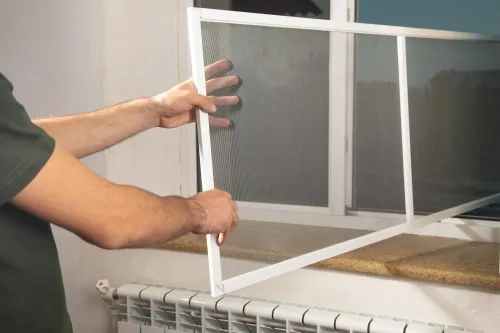
- Open the sash or sliding panel and measure the clear opening width at the top, middle and bottom. Record the clear opening height at the left, centre and right. Measure from the actual inside edges where the screen will sit, not from the outer frame or wall.
- Compare the three width readings and the three height readings. Use the smallest relevant width and height when ordering a made-to-measure mosquito net for windows, unless the supplier gives a different measuring method.
- Check the opening for square by comparing the two diagonal measurements. A noticeable difference signals that the frame, reveal or masonry is distorted; send both diagonals and photographs to the supplier instead of assuming a rectangular fit.
- Measure the depth available for the screen frame, plus any track, handle, hinge, drainage channel or overlap. Confirm that the proposed screen will not cover the operating edge or prevent the sash from opening.
- Ask the supplier to state the deduction clearly. Their drawing must show whether the clearance for the mounting frame and running tolerance is already subtracted, or whether the installer must make that deduction.
Keep the original measurements with the order. Never reduce them twice: an incorrect deduction can turn a carefully measured opening into a loose, unusable screen.
Match the Screen System to the Window and Daily Use
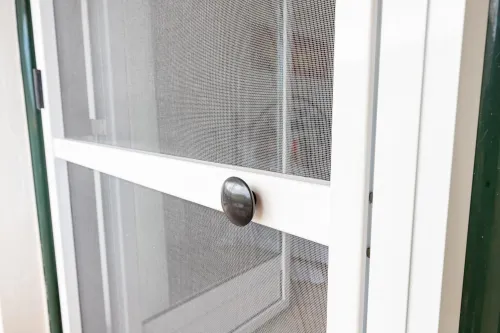
A sliding window screen suits a horizontal slider because it travels in the existing track without blocking the moving sash. Hinged windows need a system that clears the opening path, while rarely opened windows can use a fixed frame.
| Window type | Suitable system | Check before ordering |
|---|---|---|
| Sliding | Sliding panel or pleated screen | Confirm track depth and whether the screen reduces the usable opening. |
| Casement | Hinged frame, roll-down screen or casement window mosquito net | Check handle projection, hinge swing and whether the sash opens inward or outward. |
| Awning | Roll-down or hinged screen | Leave clearance for the sash and verify that the screen does not obstruct the outward opening. |
| Fixed | Fixed frame, magnetic panel or removable Velcro frame | In a bedroom, confirm the opening is not required for emergency egress; use a removable or openable design if code demands it. |
| Tilt-and-turn | External fixed, magnetic or retractable tilt-and-turn window screen | Check the two sash positions, handle clearance and the depth available around the uPVC frame. |
| uPVC | Profile-mounted magnetic, clip-in, fixed or track-based system | Match the frame profile and avoid drilling into drainage paths, seals or reinforcement. |
Choose pleated or roll-down screens where you open the window daily and want retraction. Use Velcro or magnetic panels where seasonal removal matters; choose fixed screens only where access, cleaning and emergency escape remain acceptable.
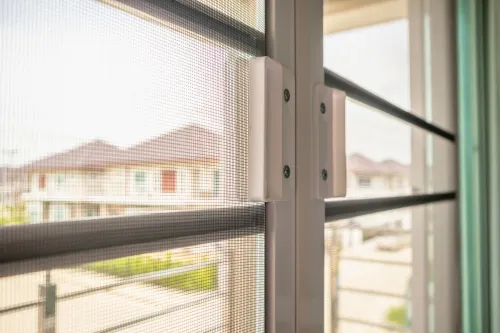
A retractable screen also needs continuous magnets or adequate overlap at the closing edge, or wind can create an insect path.
Do not treat any screen as a fall barrier, security grille or child restraint. Upper-storey windows need separate protection where required.
Compare Mesh Material, Aperture and Airflow Data
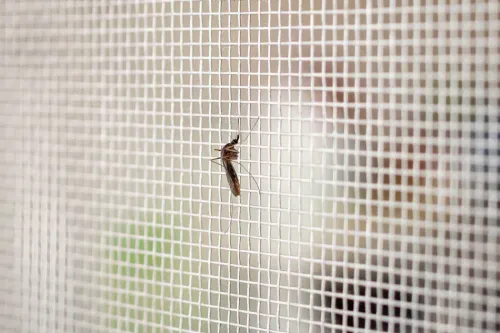
An 18×16 label does not tell you the actual opening. Compare the mesh aperture size, wire or yarn diameter, coating thickness and weave together; two screens with the same mesh count can have different clear apertures and open-area percentages.
Ask for the open-area figure and confirm whether testing follows ASTM D3656, which covers screening material, not the mosquito-tightness of the finished assembly.
| Material | Main trade-off | Ask the supplier for |
|---|---|---|
| fibreglass mesh | Flexible, light and easy to clean; it can tear or crease more readily | Yarn diameter, coating type, open-area percentage and colour |
| polyester mesh | Soft and resistant to corrosion; heavy-duty versions reduce visibility and airflow | Yarn size, tear strength, aperture and air-permeability data |
| aluminium mesh | Rigid and resistant to clawing; it can dent, corrode or show glare | Wire diameter, alloy or finish, aperture and corrosion information |
Do not choose the finest mesh by count alone. A smaller opening generally increases airflow resistance, cuts daylight and visibility, and traps dust faster; compare air-permeability or pressure-drop data at a stated test pressure. Select the smallest aperture that blocks the insects you need to exclude while retaining acceptable open area.
Pet-resistant mesh is a mechanical-strength choice, not automatically a better mosquito barrier. Physical screening also is not insecticide treatment: require a labelled active ingredient, durability claim and applicable registration or test evidence before treating it as insecticidal.
Check Clearance, Seals and Safety Before Installation
Before fitting any screen, confirm that it will not block emergency escape, interfere with moving hardware, or create an unsealed insect route. Measure the actual frame depth, side clearance, sill clearance and window handle clearance with the sash fully open and closed; the tightest condition controls.
1. Treat a bedroom or sleeping-room window as a possible escape opening. If it is designated for emergency egress, confirm whether local code requires a removable, hinged or openable screen that works from inside without tools. A fixed frame can turn a compliant escape window into a blocked opening.
2. Do not treat ordinary mesh as a fall-protection barrier, security grille or child-safety restraint. An upper-storey screen must not receive credit for preventing falls unless the complete product has been tested and approved for that purpose; install a separate guard or fall-prevention device when required.
3. Check the frame-to-reveal joint, corners, sash overlap, meeting rails, roller-shutter guides and cable or latch penetrations. A gap at any of these points lets mosquitoes bypass even fine mesh, while a poorly positioned frame can stop the sash, handle or shutter from operating.
4. Specify the closing detail for a retractable or magnetic screen. Require continuous magnets or a defined compression and overlap at the closing edge; fabric that bows or lifts in wind leaves an insect path.
A physical screen also does not equal an insecticide-treated mosquito net. Insecticidal performance requires a labelled active ingredient, treatment durability claim and applicable registration or testing. Mesh aperture alone proves none of these.
Approve the Fit with a Drawing and Sample Installation
Before approving a multi-window order, require an evidence pack that links every screen to a measured opening, not just a quotation using window sizes such as “4 ft by 5 ft.”
1. Request an annotated measurement sheet for each window. It should show clear width and height at the top, middle and bottom, frame depth, diagonals or squareness notes, sill condition and the smallest dimension used for fabrication. Confirm whether the supplier’s deduction for the frame, track or overlap is already included.
2. Ask for an opening-size drawing labelled with a unique window reference. The drawing should show screen orientation, mounting face, operating direction, finished dimensions, clearance from handles and the required removal path.
3. Inspect a section or close-up drawing showing the corner detail, brush seal and fixing points. Check that the seal closes against the actual frame, the fasteners will not damage drainage channels, and the corner leaves no gap at the mesh edge.
4. Approve one sample installation on each different frame type or mounting condition before releasing the full order. Operate the window, screen and lock repeatedly; check daylight gaps, rubbing, mesh tension, removal and cleaning access.
Whether you are reviewing a proposal from Delmen Nets 9650012393 or another supplier, mark the approved sample and drawing with the installation date and sign-off. Reject any batch whose frames, seals or fixing positions differ from that approved reference.
Related products
 | Pleated Mesh Systems Manufacturer and Supplier in Gurgaon Delmen Nets is the manufacturers and the suppliers of an excellent and superior quality of Pleated Mesh Systems... View product → |
 | Insects Screens System Manufacturer and Supplier in Gurgaon We are leading manufacturer of Insect Screen Systems from Gurgaon. View product → |
Frequently asked questions
How do you measure a window for a mosquito net?
Measure the unobstructed clear opening inside the frame at several points. Check width, height, and whether the frame is square before confirming dimensions.
Which mosquito net system suits a window best?
Match the system to the window type and how often you open it. Fixed screens suit openings that need little access, while sliding, roll-up, or hinged systems suit frequently used windows.
What should you compare when choosing mosquito-net mesh?
Compare mesh material, aperture size, airflow, visibility, durability, and the insects you need to exclude. A tighter aperture can improve protection but reduce airflow and light.
What should you check before installing a mosquito net?
Check frame clearance, seals, drainage paths, latches, and any safety risks. Approve a dimensioned drawing and sample installation before ordering the complete set.
Related products
 | Velcro Mesh Systems Manufacturer and Supplier in Gurgaon Manufacturer of Velcro Mesh Systems - Velcro Net offered by Delmen Nets are of high quality, It protect from the... View product → |
 | Roll Down Mesh Systems Manufacturer and Supplier in Gurgaon Delmen Nets are involved in the manufacturing and supplying of Roll Down Mesh Systems (Roller Mesh or Pull Down... View product → |