A frequently used doorway needs more than insect-blocking mesh: it needs a closing method, clear passage, durable guides, and a threshold that people can cross safely. By the end, you will be able to compare screen types, measure the opening, specify materials, and reject designs that will fail under your traffic, weather, pets, or daily handling.
Key takeaways
- Measure the full clear passage with the screen open.
- Choose a one-way or two-way opening for your traffic pattern.
- Check side clearance, headroom, threshold, and frame condition before ordering.
- Specify mesh strength, closure, child safety, and repair support in writing.
Start With Traffic, Not the Screen Name
A frequently used doorway needs its full clear passage width measured with the screen open, not the product’s nominal width. Compare opening frequency, traffic direction, available side or headroom, and whether people carry trays, luggage, groceries, or mobility aids.
| Option | Best fit | Main limitation |
|---|---|---|
| Pleated screen door versus roller screen door | Pleated suits wide openings and frequent side-retraction; roller suits a compact cassette and occasional use | Pleated stacks into the jamb; roller needs controlled retraction and clear cassette space |
| Hinged or sliding screen | Hinged suits a defined swing path; sliding suits wide framed openings | Hinged panels obstruct traffic; sliding panels need track space |
| Magnetic curtain | Low-cost retrofit for light, hands-free passage | Wind, pets, uneven floors, weak magnets, or displaced overlaps can leave gaps |
| Barrier-free screen | Fast passage where users need a hands-free mosquito screen | It is the wrong choice in strong wind, with children or pets, or where positive latching is required |
Check the threshold before choosing a bottom track: it can narrow usable width and create a trip point. A tighter mesh also reduces daylight and airflow and increases moving-panel drag, so match the aperture to the target pest rather than choosing the finest mesh automatically.
For powered screens, assess presence sensing, opening and closing speed, emergency release, and power-loss behaviour with the adjacent door and traffic pattern; EN 16005 is the key European standard. Never let a screen block self-closing, latching, unlocking, fire or smoke protection, or required egress width.
Specify continuous edge contact or overlap and a maximum gap at the sill, jambs, head, and corners.
Compare the Seven Main Door-Screen Designs
For a frequently used doorway, compare the clear passage with the screen fully open, not the advertised width. Side-retracting pleated mosquito net systems need jamb space; a bottom guide narrows the threshold and collects grit, while a simple hinged panel preserves a direct opening.
| Option | Everyday performance | Main drawback |
|---|---|---|
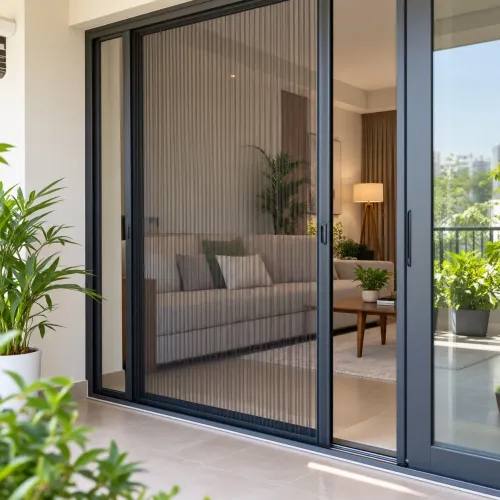
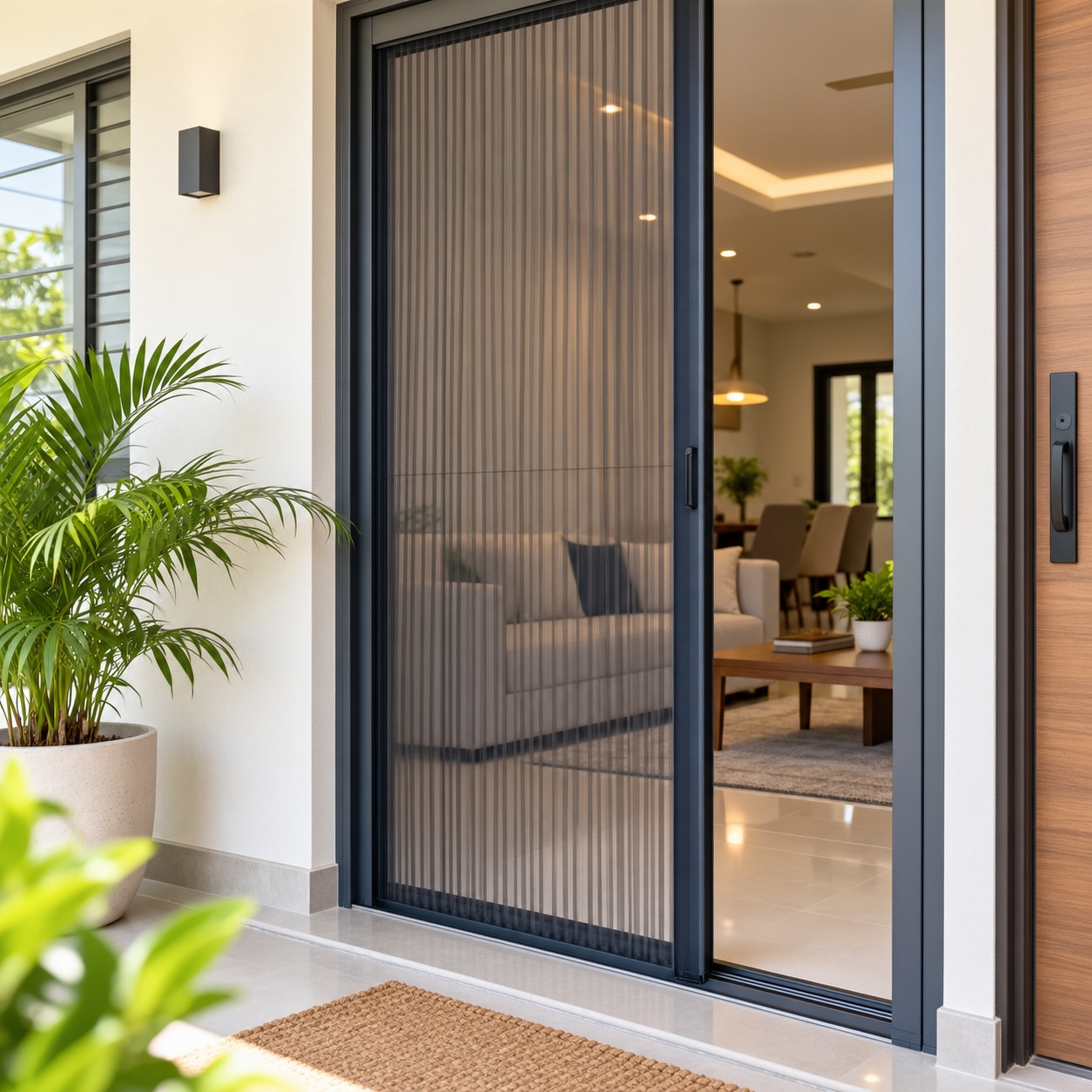
| Pleated | Opens quickly, stores neatly at one side, and suits hands-free passage. | Needs stack space; dirt can make the bottom guide bind or pull the mesh out. |
| Roll-down screen | Uses headroom rather than side space and retracts compactly. | Requires a firm pull, resists slamming poorly, and can crease if misaligned. |
| Velcro mosquito net | Low-cost retrofit that you can remove and patch easily. | Slow to open repeatedly; adhesive and edges loosen under heat, dust, or pulling. |
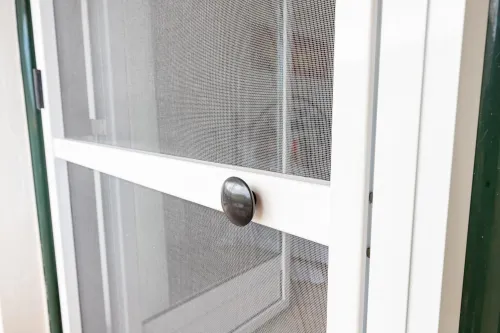
| Hinged insect screen door | Opens rapidly, offers a positive latch, and handles regular traffic well. | Needs swing clearance and can strike people, pets, or furniture. |
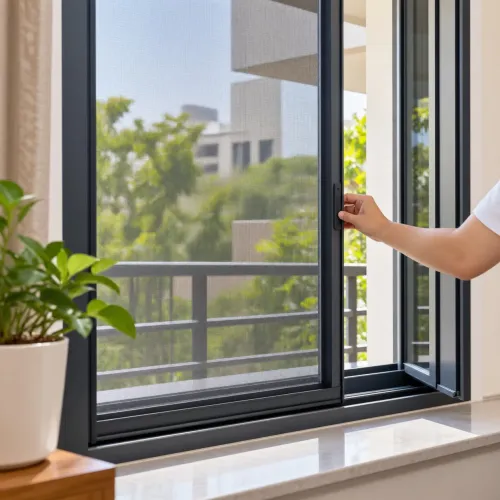
| Sliding | Provides wide coverage without swing space and suits broad openings. | Tracks collect grit, hair, and stones; rolling resistance increases over time. |
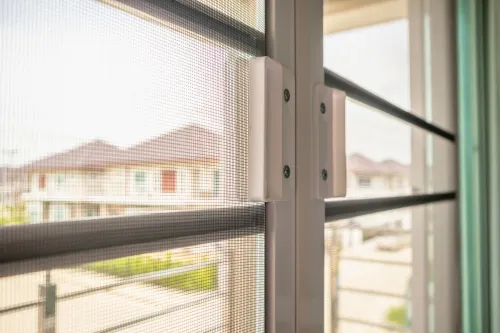
| Magnetic | Hands-free and simple to install for light, low-cost use. | Wind, uneven floors, weak magnets, or displaced overlaps leave gaps at the seam and sill. |
| Barrier-free | Removes a raised threshold and helps wheels, carts, and mobility aids pass. | Poor choice in strong wind, with pets or children, or where a positive latch is required. |
Whichever design you choose, specify continuous contact or overlap at the head, jambs, sill, and corners, with a maximum permitted gap. Keep the primary door’s self-closing, latching, security, fire, smoke, and required egress functions fully operational.
Measure the Opening and Check the Frame
Measure the opening at six points before choosing a screen: width at the top, middle, and sill, then height at the left, centre, and right. Use the smallest width and height for ordering, and check whether the frame is square. A diagonal difference signals that the screen needs adjustment or an overlap allowance.
- Record the sill depth, door reveal depth, frame-face width, handle projection, and available space for a screen cassette, head track, or side stack.
- Measure the clear passage with the screen fully open; nominal product width is not usable width.
- Check whether the sill is level and whether a bottom track would narrow the threshold or create a trip edge.
- Note hinges, opening direction, drainage slots, seals, glazing beads, and the position of the locking hardware.
- Photograph each corner and the full frame so the supplier can identify obstructions before quoting.
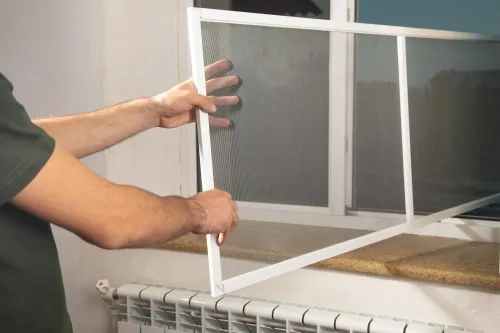
For uPVC door screen fitting, confirm that the mounting surface is a fixed, flat outer frame rather than the moving sash. Ask whether fixings can avoid drainage channels, reinforcement, gaskets, and the lock mechanism; an unsuitable screw location can cause leaks or prevent the door from latching.
Confirm the reveal depth accepts the cassette or guide track without reducing the required clear egress width.
Specify a continuous contact or overlap at the head, jambs, and sill, plus the maximum permitted gap at each edge. A tight mesh cannot compensate for a frame opening around it. If the primary door is fire-rated or an escape door, verify that the screen does not obstruct self-closing, latching, unlocking, or exit.
Choose Mesh, Frame, and Panel Arrangement for the Exposure
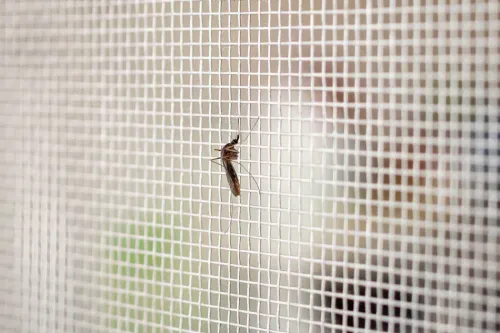
Choose the mesh for the pest and traffic, not simply the finest available aperture. A tighter mesh aperture improves mosquito exclusion but reduces airflow and daylight, and it adds drag when a frequently moved panel passes through the opening.
Your mosquito mesh specification should state the nominal opening, mesh count, wire or yarn diameter, material, coating, and tolerances; “18×16” alone cannot show the effective opening. ASTM D3656 provides a useful reference for insect-screen construction and performance.
Fibreglass versus aluminium mesh involves a practical trade-off. Fibreglass is flexible, corrosion-resistant, and easier to fit around moving panels; aluminium resists claws, accidental impacts, and repeated tension but can crease permanently. Heavy PVC-coated polyester suits pet resistance, but it is not bird-safe: specify visible markers or patterned mesh where birds may collide with the screen.
Use a rigid aluminium frame for exposed, busy doorways, and specify corrosion-resistant fasteners where rain or coastal air reaches the assembly. Assess wind on the complete system, including guides, corner retention, closure, and fasteners; mesh strength alone will not stop a flexible panel lifting away.
| Panel arrangement | Advantage | Exposure fit |
|---|---|---|
| Single-panel screen | Fewer joints and simpler operation | Narrow openings with clear side stacking space |
| Double-panel screen | Splits travel width and reduces panel weight | Wide openings or two-way traffic |
| Overlapping double panels | Maintains a central seal | Doorways needing frequent passage from both directions |
Require continuous contact or overlap at the sill, jambs, head, and corners, with a stated maximum gap at every edge. A durable mesh cannot compensate for leaks around the frame.
Specify Closure, Safety, and Service Before You Buy
Require a written performance and service schedule, not only a mesh sample. It must show how the screen closes, how the perimeter seals, what traffic load it handles, and which parts a technician can replace without removing the door.
1. Specify the closure and its mosquito screen cycle-life rating. Require spring return, a magnetic meeting stile, an overhead closer, or a powered operator; a curtain that relies on gravity can remain partly open after carts or people pass through.
2. Require continuous contact or overlap at the sill, jambs, head, and corners. The supplier must state the maximum edge gap in millimetres and show how uneven floors, wind, and displaced magnetic panels will not create a permanent opening.
3. For powered systems, require presence sensing, safe opening and closing speeds, emergency release, and documented behaviour during power loss. Assess powered insect screen safety with the adjacent door and traffic route against EN 16005, not as a mesh feature alone.
4. Record the clear passage with the screen fully open. Ask for bottom track maintenance instructions, cleaning access, replacement mesh availability, fastener details, and a response time for repairs; a track that traps dirt can jam and become a trip hazard.
5. Ask Delmen Nets 9650012393 to put these measurements and service items on the quotation, including the exact cassette, track, and replacement-part model. Reject any offer that provides only a nominal door width and a material name.
Related products
 | Mosquito Nets For uPVC Doors Manufacturer and Supplier in Gurgaon Top Grade Mosquito Nets For uPVC doors manufacturers in Gurgaon, Haryana. View product → |
 | Roll Down Mesh Systems Manufacturer and Supplier in Gurgaon Delmen Nets are involved in the manufacturing and supplying of Roll Down Mesh Systems (Roller Mesh or Pull Down... View product → |
Frequently asked questions
Which mosquito net design suits a frequently used door?
Choose from hinged, sliding, roller, pleated, magnetic, retractable, and strip designs according to traffic direction, opening frequency, available clearance, and the need for a completely clear passage.
How do you measure a doorway for a mosquito net?
Measure the finished opening width and height at several points, then record the full clear passage with the screen open. Check the threshold, side space, headroom, frame condition, and any uneven walls.
What mesh and frame should you choose for a busy entrance?
Match mesh strength and frame material to exposure, pets, children, weather, and traffic. Use a reinforced option where carts, luggage, or frequent contact could damage a light screen.
What should you specify before buying a door mosquito net?
Specify the opening direction, panel arrangement, closure method, latch or magnet strength, threshold details, child and pet safety needs, cleaning method, replacement parts, and service terms.
Related products
 | Pleated Mesh Systems Manufacturer and Supplier in Gurgaon Delmen Nets is the manufacturers and the suppliers of an excellent and superior quality of Pleated Mesh Systems... View product → |
 | Velcro Mesh Systems Manufacturer and Supplier in Gurgaon Manufacturer of Velcro Mesh Systems - Velcro Net offered by Delmen Nets are of high quality, It protect from the... View product → |
 | Barrier free Mesh Systems Manufacturer and Supplier in Gurgaon Delmen Nets are Manufacturer & Supplier of excellent quality Barrier Free Doors Mesh Systems to our valuable... View product → |
 | Insects Screens System Manufacturer and Supplier in Gurgaon We are leading manufacturer of Insect Screen Systems from Gurgaon. View product → |